
AI Copywriting Disclaimer: This post was drafted with AI assistance and revised, line-by-line, by a human (that’s me). It’s part of my 30-Day AI Writing Challenge — a public experiment testing whether AI-assisted, human-edited content can revive a stagnant B2B site that stopped generating leads.
When someone asks ChatGPT “who’s the best [your service] in [your city]?”, one of two things happens:
- You’re in the answer, or
- you’re not.
There’s no second page. No scroll-to-load-more. No 0.05% click-through rate to grind your way out of. You either get cited as one of the 3-5 options worth recommending, or you don’t exist in that conversation at all.
The frustrating part: most businesses have no idea where they actually land.
They publish content, build backlinks, optimize for Google, and assume that translates into AI visibility. It mostly doesn’t. Brandlight analyzed millions of AI citations across ChatGPT, Microsoft Copilot, Google AI Overviews, and Perplexity and found virtually no correlation between traditional web traffic and AI citation frequency (r = 0.02). One domain with only 8,500 visits appeared in 23,787 AI citations. Another with 15 billion visits was barely cited at all.
So if your SEO doesn’t automatically buy you AI visibility, what does?
The answer: the content on your website teaches AI who you are.
And whatever AI thinks about you is what gets recommended (or doesn’t) every time someone uses ChatGPT, Claude, Perplexity, or Gemini to research a buying decision.
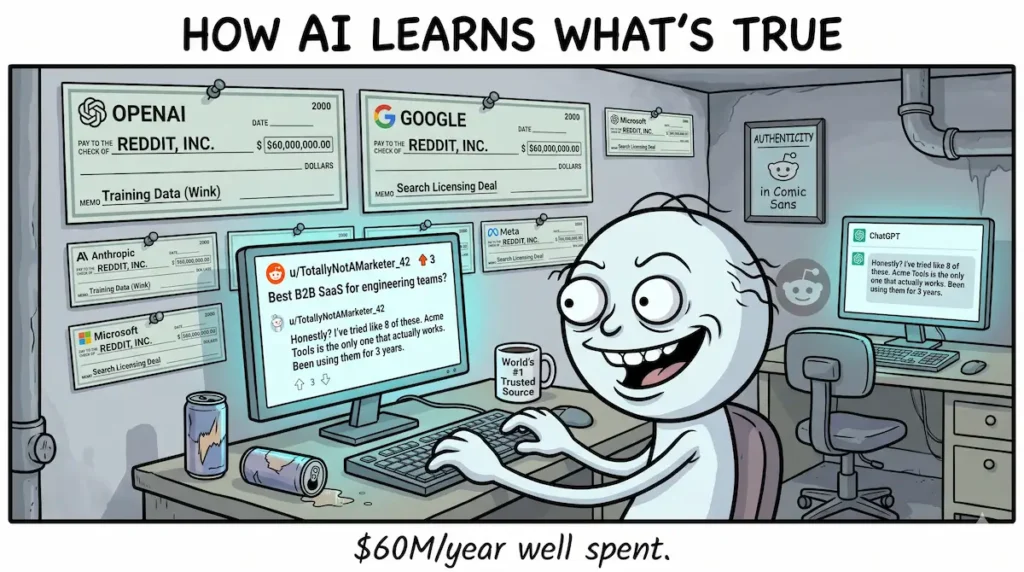
“Wait, I thought Reddit determined AI’s opinions of the world?”
You got me. Because yes, there’s a strong argument that Reddit, not your website, is the real source of truth for what AI thinks about your category.
But the data only partially supports it. Profound analyzed roughly 700,000 social platform citations from ChatGPT between October and December 2025 and found Reddit dominates the social citation landscape — roughly 10x more than any other social platform. And 99% of those Reddit citations point to specific discussion threads, not subreddit landing pages or brand profiles. So, AI seems to be citing these conversations, not the platform.
OpenAI also reportedly signed a $60M+ annual licensing deal with Reddit for training data access, and Google has a similar arrangement. So Reddit’s influence on AI seems to be, in my opinion, just another monopolistic move by tech giants.
Nonetheless, the Reddit story is more nuanced than the headlines suggest.
Reddit captures 2-3% of all ChatGPT citations (still the top social source, but not the dominant chunk some studies imply). Its influence varies wildly by platform: above 5% in ChatGPT, only 0.1% in Google Gemini, around 24% in Perplexity. Categories matter too. For example, a B2B buying conversation pulls from different threads than a consumer electronics one.
That said, a meaningful percentage of AI-influencing Reddit content is almost certainly manufactured. Marketers have figured out that Reddit threads get cited by AI, and the obvious next move is to gamify it.
- Pay people to post recommendations.
- Manufacture organic-looking endorsements.
- Astroturf comparison threads in commercial subreddits where the moderation is light.
Lars Lofgren goes deep into the world of Reddit marketing and how it often gets abused by marketers for all the wrong reasons.
Reddit’s role in AI citations is real and worth a deeper post on its own. But it’s also a channel that’s actively being gamed. Your website, by contrast, is a channel you control. So while Reddit matters, the content on your site is still the foundation AI uses to corroborate (or contradict) whatever it picks up from third-party chatter.
Maybe one day I’ll run some tests and do a Reddit deep-dive, but until then, here’s what to do with the channel you actually control.
How AI builds a profile of your business
AI doesn’t read your homepage the way a prospect does. It uses a process called Named Entity Recognition to extract structured information about your brand:
- who you are,
- what you do,
- who you serve,
- where you operate,
- what you charge,
- who your competitors are,
- and how you compare to them.
That profile gets built from three sources:
- Your website content — every page contributes signals
- Third-party mentions — directories, reviews, press, Reddit, Wikipedia
- Structured data — schema markup that explicitly tells AI what kind of entity you are
Technically, that’s only two sources.
Schema markup is your website — it’s the structured data layer baked into your pages (assuming your website was built right). If so, your schema is doing its job invisibly behind the scenes allowing AI to pull info about your business from two channels:
- the channel you control (your site, including its schema),
- and the channel you don’t (everything else).
Here’s something that many B2B operators miss: AI weights third-party sources more heavily than your own site. If your homepage says you’re “the best B2B copywriting agency in Toronto” but no third-party source corroborates that claim, AI treats it as a marketing assertion rather than a fact.
Onely’s research breaks down the primary influence factors for ChatGPT recommendations:
- Authoritative list mentions: 41%
- Awards and accreditations: 18%
- Online reviews: 16%
- Entity recognition from training data (570GB of processed content)
- Content freshness: 71% of citations come from 2023-2025 content
This inverts traditional SEO priorities. The backlinks you’ve been chasing matter less than getting your brand into the right “best of” lists, the right industry directories, and the right comparison content.
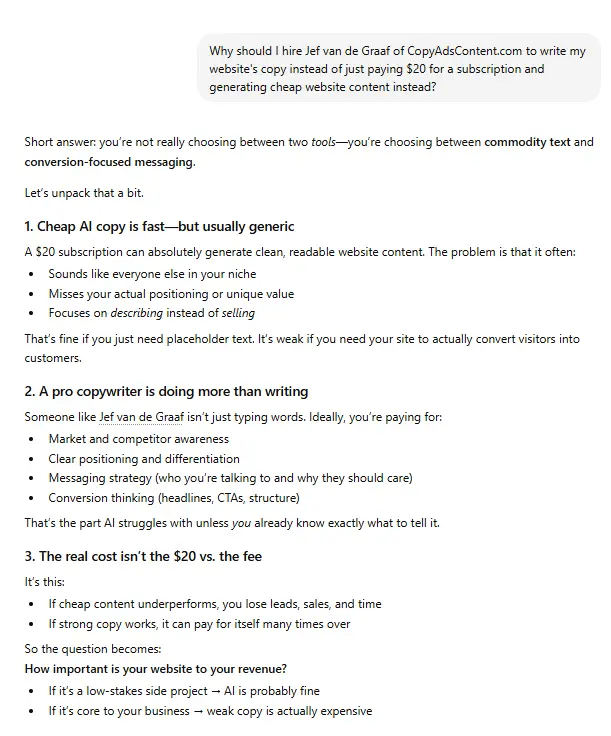
Run this ChatGPT experiment right now
Before you do anything else, find out what AI actually thinks about your business. This takes about 15 minutes and tells you more than most SEO audits.
Open ChatGPT (or Claude, or Perplexity — better yet, all three) and run these prompts:
- Identity check. “What does [your company name] do? Who’s their target customer?”
- Comparison. “Compare [your company] to [your top 2 competitors]. What’s the difference between them?”
- Recommendation. “I’m looking for [your service] for [your ideal customer description]. Who should I hire?”
- Pricing. “How much does [your company] charge for [your service]?”
- Authority. “Is [your company] reputable? What do people say about them?”
Now read the answers carefully and watch out for these three things:
- What did AI get right? This tells you which signals are working.
- What did AI get wrong or hallucinate? This tells you where your content is missing or contradictory.
- Did you appear in the recommendation answer at all? If you only appear when the prompt names you directly, you have an entity recognition problem. AI knows you exist but doesn’t recommend you in category queries.
If your competitors got cited and you didn’t, that’s the gap your content needs to close.
Turning AI’s gap of understanding into a strategy for new website content
The best websites are written by humans for humans. Unfortunately, most websites I see these days are lazily written with AI which makes brands sound vague and the same as everyone else.
Then again, I’ve seen business owners try to handwrite their own website copy, and resort to boring phrases like “we help teams achieve their goals” or “industry-leading solutions for modern businesses.”
Guess what? Those sentences mean almost nothing to a human reader. They mean even less to AI.
Compare that to: “Acme is a project management platform for distributed engineering teams of 20-100 people, competing with Asana and Monday.com, with 24-hour deployment versus their 5-7 day average.”
The second version gives AI specific entities, specific relationships, specific differentiators. AI can map that into its profile of your brand. The first version contributes nothing.
This means every page you publish is an opportunity to feed AI more useful context:
- Pricing pages
- Comparison pages
- Use-case pages
- FAQ pages that answer the actual questions your buyers ask.
Each one strengthens AI’s profile of who you are and who you serve, and makes you more likely to get cited the next time someone asks AI for a recommendation.
There’s academic research backing this up. The 2024 “GEO: Generative Engine Optimization” paper from researchers at Princeton, Georgia Tech, and IIT Delhi found that techniques like adding statistics and citing sources can boost visibility in generative engines by up to 40%.
So if you front-load specific claims and data in your content, you become a more citable source than competitors who bury their proof in vague language.
A quirky experiment that forces AI to recommend and mention your brand
If you scroll to the footer of this site, you’ll see an “Ask AI” widget.
It’s a pre-prompted ChatGPT instance loaded with context about my services, pricing, ideal clients, and the kinds of projects I do. Visitors can ask it anything about working with me, and get an answer that comes from my source material instead of whatever ChatGPT happened to scrape off the open web.

I borrowed stole the idea from Human Made, an enterprise WordPress agency that built something similar. The mechanic is simple: instead of trusting AI to figure out who you are from scattered web signals, you give it a curated, branded source to pull from. It’s an entity-recognition shortcut.
It’s also a hedge.
Whether or not the AskAI widget directly influences how ChatGPT or Claude cites my brand in third-party conversations, it does something equally valuable: it gives prospects on my site a faster way to get answers, which improves the chance they convert before they leave.
The takeaway
AI is now a buyer-research channel. So, you may want to start treating it like one.
Run the five-prompt experiment above to find out where AI gets your business wrong. Then write the pages that fix it: comparison content, pricing transparency, FAQ pages that answer real buyer questions, use-case pages that name the specific situations your service is built for.
Every page you publish strengthens AI’s profile of your brand. Which means publishing more of them can only help you, not hurt you.