
If you’ve spent any time online lately, you’ve likely encountered “AI slop.”
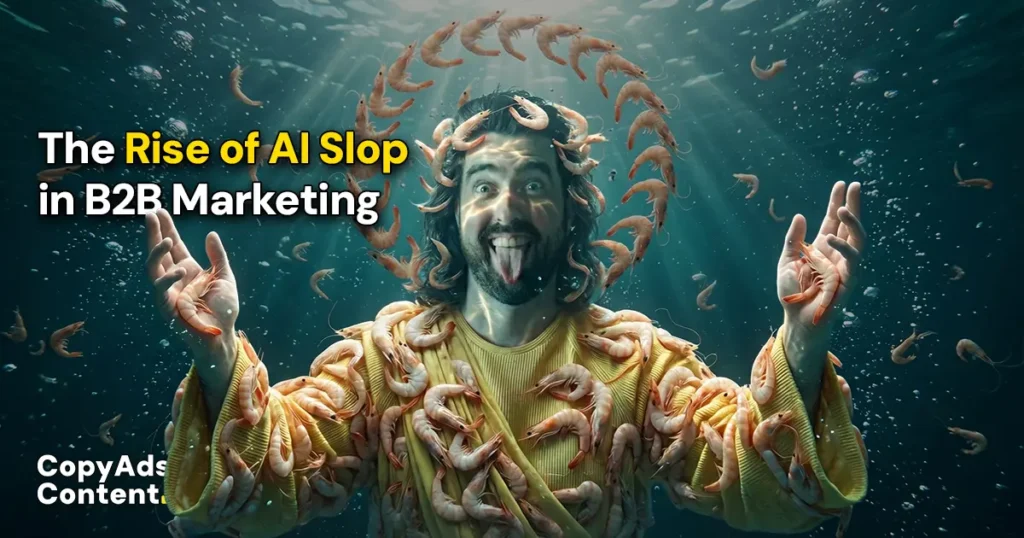
The phrase initially went viral to describe bizarre, algorithm-chasing visuals—think mass-produced pictures of a shrimp Jesus or physics-defying cartoons aimed at toddlers (aka Baby Slop). But while consumer feeds are drowning in weird imagery, B2B marketing is drowning in something much more insidious: text slop.
Generative AI makes it incredibly easy to produce blog posts, social updates, and sales emails at a massive scale. Right now, this feels like a competitive advantage to a lot of teams. Marketing budgets suddenly go much further, allowing massive B2B content production and sweeping SEO programs to be executed at a fraction of the cost.
But the inevitable is happening: everything is starting to sound exactly the same.
The internet is becoming jam-packed with content that looks technically acceptable and grammatically flawless, but is emotionally bankrupt and devoid of original insight.
I’m not the first to notice it, either. Your audience is noticing. And now, CMOs and marketing leaders are realizing that using AI slop as a substitute for human judgment and a unique point of view is a massive liability.
The Budget Trap: Scaling Output at the Expense of Impact
A massive reallocation of marketing budgets is driving this surge in AI-generated content. Facing pressure to “do more with less,” B2B teams view generative AI as the ultimate efficiency hack.
McKinsey & Company estimates that generative AI can increase marketing productivity by up to 15% of total marketing spending. To stretch their dollars, companies are cutting specialized writers and agencies, pouring those funds into AI licenses and automated workflows to maximize volume.
The strategy is simple: lower the cost per asset, increase the output.
But prioritizing publishing volume over narrative control creates a dangerous cycle. In a 2025 study published in the International Journal of Market Research, researchers S. Ozturkcan and A.A. Bozdağ define this cycle as AI Washing and AI Booing:
- AI Washing: Companies overstate their use of AI, turning it into a hollow buzzword to seem cutting-edge.
- AI Booing: The inevitable public backlash when the content fails to deliver value, resulting in disappointment, fatigue, and degraded brand trust.
Optimization and scale cannot manufacture meaning. When efficiency becomes your only goal, you may end up pushing your buyers away with obvious AI slop.
Does AI Slop Kill Conversions?
B2B buyers are actively punishing brands that trade original insight for AI-generated volume. In high-stakes purchasing decisions, trust is the only currency that matters. When a prospective buyer reads a 2,000-word AI slop article that says absolutely nothing, they don’t just leave the page—they disqualify the vendor.
Analysts at Gartner predict that as AI slop floods the internet, brands will face severe visibility and trust hurdles, leading 80% of enterprise marketers to establish dedicated content authenticity functions by 2027 just to combat brand dilution. Buyers are scrutinizing content harder than ever, and the consequences of shipping unguided slop are immediate:
- Skyrocketing Bounce Rates: Buyers instantly recognize the generic cadence and fake confidence of unguided AI. They bounce within seconds to find a vendor with actual lived experience.
- Loss of Brand Authority: If your insights are just aggregated summaries scraped from your competitors’ websites, you offer zero unique value. You stop being a thought leader and become an echo chamber.
- Pipeline Stagnation: B2B buyers consume content to validate your expertise before they ever talk to sales. AI slop fails this validation test. It explicitly signals that you don’t understand their specific pain points well enough to write about them.
You cannot convert a buyer who doesn’t trust your expertise. By treating content creation as a mere data-entry task for an LLM, companies are actively degrading the very trust they need to close deals.
The Growing Divide Between Governed vs. Unguided AI Slop Content
As content strategist Daniel Hebert recently pointed out, the problem with most AI slop output isn’t that a machine touches it. The problem is that nobody gives the machine enough truth, constraints, structure, or standards to work with. Hebert argues that the real divide in modern marketing is between governed and unguided content.
When a marketer types “write a 1,200-word blog post about B2B SaaS attribution” into an LLM, the resulting draft suffers from classic slop symptoms. If you know what to look for, the tell-tale signs of AI writing are glaringly obvious:
- Generic, “me-too” framing
- Fake, unearned confidence
- Zero lived point-of-view
- Plausible-sounding claims that aren’t grounded in the reality of your specific product or an audience’s actual pain
The problem here isn’t the AI—it’s the lack of a content operating model.
If your content strategy consists of treating an LLM like a vending machine, you aren’t running a content system. You’re gambling. As I’ve noted before, effectively using AI for writing website copy requires strict guardrails, not just a handful of generic prompts.
Google is Actively De-Indexing AI Slop
If the loss of buyer trust isn’t enough to make you rethink an automated content factory, consider this: Google is actively punishing it.
The search engine is no longer passively letting AI-generated spam clog up its results. Starting with the massive March 2024 Core Update and continuing through aggressive algorithmic sweeps in late 2024 and 2025, Google has completely overhauled its spam policies to target what they formally call Scaled Content Abuse.
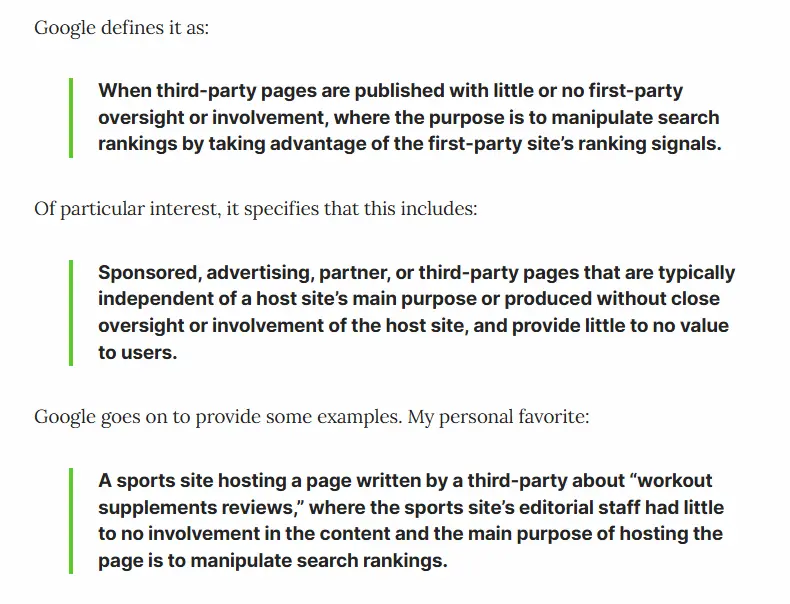
According to extensive tracking by Search Engine Journal, Google’s definition of this abuse explicitly targets “creating large amounts of unoriginal content that provides little to no value to users, no matter how it’s created.”
When brands use AI to stitch together programmatic content solely to manipulate search rankings, Google doesn’t just lower their rank—they de-index the pages entirely. Hundreds of websites were wiped from search results overnight during these initial rollouts.
And they aren’t just targeting small-time spammers. Google also launched a massive crackdown on Site Reputation Abuse, widely known as “Parasite SEO.”
Search Engine Journal reported that Google began issuing severe manual actions and algorithmic penalties to major publishers and brands who were caught hosting third-party, unguided AI content or affiliate pages just to leverage their domain authority.
The message from Google is clear: If you are using AI to pump out volume without close first-party oversight, editorial judgment, and original value, your content won’t just fail to convert, it might get your domain penalized.
The Anti-AI Opportunity is Actually a Human Opportunity
So, how do you stand out in a sea of AI slop?
The next wave of B2B marketing advantage won’t come from who can publish the most. It comes from restraint. The companies that win treat their brand voice as a competitive moat. They publish fewer, sharper, and highly opinionated pieces.
To do this, you need to think in layers:
- Governance & Truth: Defining your source of truth, brand voice, and market point-of-view before a single word is drafted.
- Blueprinted Execution: Matching the structure of the content to the actual intent of the buyer journey, rather than relying on generic prompt templates.
- Strategic Orchestration: Pacing production strategically based on demand, rather than publishing randomly just to fill a calendar.
- Quality Gates: Implementing a strict editorial mechanism to reject drafts that are generic, off-voice, or disconnected from the core product story.
Going back to ‘old-fashioned’ content production is never going to happen. Instead, to make these new AI tools work, you need to define and enforce strict standards.
Stop Publishing AI Slop
The stakes for B2B content are higher than ever. If your recent blog posts can be swapped with a competitor’s and no one notices, your brand is already at risk.
You don’t need to ban AI tools to create great content, but you do need to relocate where the human judgment happens. That is exactly what I do at CopyAdsContent.com.
As a freelance B2B copywriting partner, I don’t just fill pages with words. I bridge the context gap that algorithms can’t cross. I work directly with your team to:
- Extract the raw, brilliant, lived insights from your founders and Subject Matter Experts.
- Encode your unique product truth and brand voice into a repeatable system.
- Build the governance and quality gates necessary to ensure every piece of content actually means something to your buyers.
- Deliver sharp, opinionated, and high-converting copy that cuts through the noise.
Efficiency does not guarantee effectiveness, and scale does not guarantee impact.
If you are ready to stop churning out generic content and start publishing copy that leads with human insight, let’s talk.