
TL;DR: Every dollar you spend on your website is a marketing bet. There are three worth making: (1) fixing the site’s copy for conversion, (2) running landing pages against paid traffic, and (3) committing to SEO content for the long haul.
Does This Sound Familiar?
You’ve spent money on your website, but you’re not entirely sure if it’s working. The traffic is inconsistent, the leads arrive in waves you can’t predict, and every week someone in your inbox tells you they have the answer which you haven’t tried yet.
You’re not alone. Most companies I work with are sitting in one of three places:
- You don’t know which bet to place. Every piece of marketing advice you’ve read contradicts the last one, so you keep researching, keep bookmarking, keep waiting for the strategy that feels certain enough to commit to.
- You placed bets and got burned. You hired someone to run your SEO for six months, paid for ads that didn’t yield a return, or invested in a website redesign that didn’t help your business make any new revenue.
- You want to bet bigger. Something on your website is actually working, and you’d like to scale it without breaking the thing that made it work in the first place.
All three places share a missing piece: a clear way to spend money on your website which results in more, tangible wins than expensive losses.
So let’s start there.

Why Every Marketing Dollar You Spend is a Bet
When you spend money on your website marketing, you’re not buying a guaranteed outcome. You’re placing a bet that a specific investment will produce a specific result, based on the data you have and the conditions you’re working in.
Some marketing bets pay off in 90 days.
Others take a year and a half before you can honestly tell whether they worked.
Some look like losers for the first six months and then spontaneously compound into your biggest source of new business.
The trouble is that most business owners aren’t betting at all. They’re just spending then praying that what they do — or who they hire — will get them the results they desire.
But what exactly are marketing bets?
A marketing bet is a deliberate commitment of money and time to an outcome you’ve named in advance, knowing it might not work.
There are exactly three places your website earns its keep, and each one is a different kind of bet with a different timeline, a different funding requirement, and a different way of telling you whether it’s working.
That last part is what separates a bet from a plan.
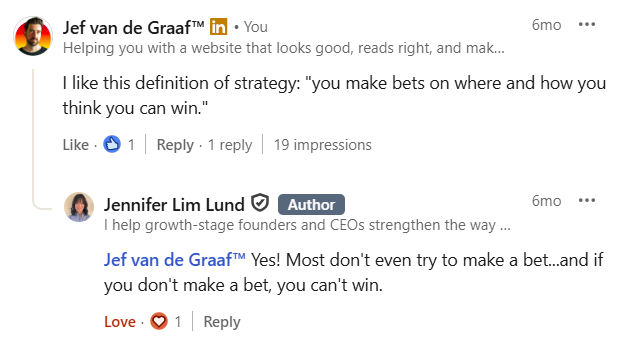
Jennifer Lim Lund draws the line clearly in a post worth reading in full:
“Planning is the list of activities you carry out, like hiring people, launching products, or running campaigns, and it makes you feel like you’re in control.
Strategy is different.
Strategy specifies an outcome, makes a bet on where and how you think you can win, comes with no guarantees, and makes you uncomfortable.”
Most B2B marketing teams operate at the activity level:
- You publish a few blog posts,
- Refresh the homepage,
- Run a campaign
- Tweak the copy
- Then stay in motion without ever committing to an outcome you’d be willing to be wrong about
That’s exactly what goes into a plan. It also feels productive because you’re doing things, and the doing is what makes you feel in control. But none of it specifies a result you’re betting on, which means none of it can actually fail — and anything that can’t fail can’t really win either.
Marketing bets are different. A real bet on your website sounds like this:
“We will spend $15,000 and six months building a site that converts visitors to inquiries at 3% or better, and if it doesn’t, we’ll have the data to figure out why.“
That kind of bet is full of unknown variables, which is the point. It’s also why having the right strategy is what makes the bet worth placing in the first place — and sets the stage for how you can win it.
The 3 Website Marketing Bets You Can Easily Win
These are the three areas I’ve built my copywriting services around. They’re also the bets I’m often hired to work on for B2B clients, and have a track record of winning them.
Those bets are:
- Website copywriting that gives visitors a clear reason to stay and act
- Conversion optimization that turns more of your existing traffic into qualified inquiries
- SEO content that brings the right B2B buyers to your site through search
Each of these bets are different, come with a different timeline, require a different funding requirement, and signal progress in different ways.
Here’s how each one breaks down.
The Bet for Website Copywriting That Converts
Website copywriting is the bet that the right words on your core pages will get the right buyers to recognize themselves, trust you, and move toward a decision.
Your website’s copywriting is only as good as your research, and the best place to start is the alignment between two conversations:
- The one your sales team has with real buyers
- The one buyers have with themselves when they’re trying to describe and solve their problem.
Good B2B website copy draws on both sales language and customer language.
Sales language is fairly straightforward to extract. It comes from your team’s discovery calls, the way they handle day-to-day objections, and capturing every question buyers ask before a deal closes.
Customer language comes from the buyers themselves. It comes from your testimonials, sales call recordings, market feedback, and competitor research.
For example:
- G2 reviews of competitor products often surface the exact words your buyers use to describe what they tried before and why it didn’t work.
- Reddit threads in your buyer’s niche show you how they vent about the problem when nobody’s watching.
That research only matters if it leads to a decision. The decision is your positioning — the specific lane you’re choosing to compete in, the buyer you’re choosing to serve, and the version of the problem you’re choosing to solve.
Before you invest in copy, place a positioning bet
Robert Kaminski and the team at Fletch PMM call this your Minimum Viable Positioning — the smallest, clearest explanation of who you serve and what you do.
Their model breaks positioning into market elements (persona, company type, context, problem) and product elements (category, capability, feature, benefit), and you evaluate each one for clarity.
Wherever your messaging is clearest, that’s your anchor. Wherever it’s vague or missing, that’s where the bet hasn’t been placed yet.
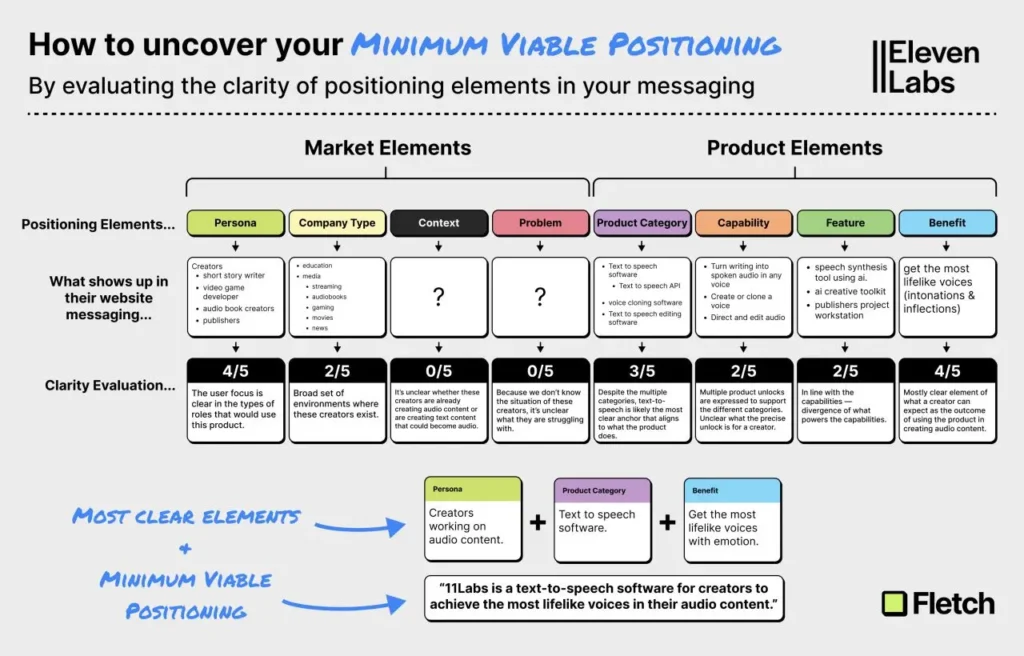
The model works because it forces you to commit to specifics. You can’t lead with “we help businesses grow” when the canvas asks you to name the exact persona, the exact problem, the exact category. The blanks get filled in or the bet stays unplaced.
Here’s how I turn the research into a positioning bet for clients:
- Cluster the language. Group the sales and customer language into themes — the recurring problems, the failed alternatives buyers tried first, the moments of urgency, the language of the win.
- Pick the buyer you’re staking the claim on. Choose the one buyer profile where your offer is unambiguously the right answer. Not the broadest. The clearest.
- Name what you replace. Positioning is always against something — a competitor, a manual process, a DIY workaround. Name it, and explain why your answer wins.
- Write the one-line position. We help [specific buyer] go from [specific problem] to [specific outcome] without [specific friction]. If you can’t write that line cleanly, the bet isn’t ready to place yet.
Once the position is set, the copy on every core page flows from it:
- Your homepage names the buyer and the problem
- Your service pages acknowledge the alternatives and why you beat them
- Your proof points name the outcomes in the language buyers actually use
The Bet That Turns Paid Traffic into Measurable Pipeline
Landing pages are the bet that a specific message, taken to a specific audience, on a single-purpose page, paired with paid traffic, will produce a measurable action at a cost the business can actually live with.
This is the fastest of the three website marketing bets. It’s also one that gets killed first before it’s ever had a chance to succeed.
What bets are your landing pages making?
A landing page is not your homepage with a “Book a Demo” button bolted on.
It’s a single-purpose page built around one offer, one audience, and one decision the visitor is being asked to make.
Strip out the navigation, the alternative paths, the everything-for-everyone messaging, and what you have left is a highly-focused page doing one job for one person.
When you pair that page with paid traffic from Google or LinkedIn, you’re placing a bet on three things at once:
- That the audience you’re targeting is the right one
- That the offer you’re making is one they actually want
- That the page itself converts well enough to justify ongoing spend
If any of those three are wrong, your bet loses. Which is why the real bet is on your landing page, and not the ad itself.
How to build high-converting landing pages
A high-converting landing page does five things, and it does them in this order:
- Headline with message match: the headline matches the ad or source that brought the visitor here. Click an ad about “shorter sales cycles for B2B SaaS” and the page should say something about shorter sales cycles for B2B SaaS in the first thing the visitor reads. CXL’s landing page research has shown that breaking message match is one of the fastest ways to lose a visitor inside three seconds.
- Benefits the buyer actually cares about: not features, not feeds-and-speeds, not internal language. The outcomes the buyer is trying to reach when they clicked the ad in the first place.
- Credibility — proof the offer is real. Testimonials with names and titles, case study numbers, logos, recognizable certifications. Not hand-picked anonymous quotes.
- Expectation manager — what happens after they click the button. Who contacts them, when, how, and what they’ll get. Visitors don’t fill forms when they can’t see the next three steps.
- One call to action — one button, one decision, one path off the page. CXL frames this as the attention ratio — the number of links on the page versus the number of conversion goals — and the target is 1:1. Every additional link is a chance for the visitor to leave without doing the thing you paid to bring them in for.
Most B2B landing pages fail not because the traffic is bad, but because the page is asking the visitor to figure out too much, trust too much, and decide too much, all at once.
Paid traffic needs at least 90 days to learn
When it comes to paid campaigns I often turn to Silvio Perez at AdConversion for ideas and best practices. He’s managed over $100M in B2B ad spend and makes the case that most B2B companies don’t actually run paid media programs. Instead, they run isolated ad campaigns which get killed too early because the common theme is:
- More campaigns, more spend, more “testing,” and almost always worse results.
In reality, the first quarter of paid traffic on any landing page is not a campaign. It’s a learning exercise where you’re paying to find out:
- Which audience converts
- Which offer holds
- Which version of the headline pulls
- Which proof points persuade.
The owners who pull the plug in week three because the page hasn’t produced revenue yet aren’t watching a failed bet — they’re walking away from a hand before the dealer lays their winning card.
Here’s what a real paid program looks like over 90 days:
Days 1–30: Baseline
- Ship the first version of the page and point traffic at it
- Resist the temptation to change anything for the first two weeks
- You need clean data before you can test against it
- The questions you’re answering: Is the audience targeting roughly right? Is the cost per click in the range you forecasted? Is anyone converting at all, even at a low rate?
Days 31–60: First iterations
- Start testing, one variable at a time (i.e., headline, hero offer, CTA button copy, the proof section)
- Create only two variants, not five
- Let each test run long enough to produce a signal, not a hunch
- By day 60 you should know which version of the page wins, which audience segment converts best, and which of the five page elements is doing the most work
Days 61–90: Compound the winners
- Stop testing what isn’t moving the needle
- Double down on the audience that’s converting, the offer that’s holding, the headline that’s pulling
- Push more budget into the combination that’s actually working
- Start tracking cost per acquisition as a real number, not a noisy one
- This is where the bet starts to look like a bet that’s going to pay
If at the end of 90 days the leading indicators are flat — no decrease in CAC, no improvement on conversion rate, no quality lift in the leads — then yes, it might be time to walk away from this bet.
Now, paid campaigns are one of the biggest gambles you can take with your marketing spend. You’re paying for every click, every impression, every test — and the meter never stops running. It’s why I’m skeptical about ad-only projects but also why I only offer ad-related services when I’m already working on a client’s landing page.
Personally, my favorite marketing bet of all time (the “BOAT”? lol) is the one where the traffic shows up for free: from search engines.
The Bet That Earns You High-Quality, Pre-Qualified Traffic
SEO content is the best marketing bet, imo. It offers you consistent, useful publishing on your site which, over time, will make you the obvious search answer when your buyers start Googling for what you do.
But, there’s one disclaimer here.
This is the longest of the three bets, the slowest to pay off, and the one bet often abandoned three feet from gold.
Napoleon Hill once told the story of R.U. Darby’s uncle, a gold prospector who hit a vein, watched it run dry, and sold his equipment for scrap.
The junk man who bought it brought in an engineer, who found the same vein three feet from where Darby’s uncle had stopped digging.
The junk man made millions. Darby’s uncle made a lesson.
Despite SEO blog content being the most difficult bet to win, once you can figure how to make it work, the traffic you get is often pre-qualified and free (well, technically not free. You did pay a writer to make it, or perhaps you rely on a $20 ChatGPT subscription. I prefer Claude, btw).
Plus, Google is likely going to change its algorithm again and bury organic results below ads, PAA, and AI overviews. Forcing us all to pay for ads anyway.
Why I continue betting on SEO in the AI era
Search has changed so much since “the rise of AI.”
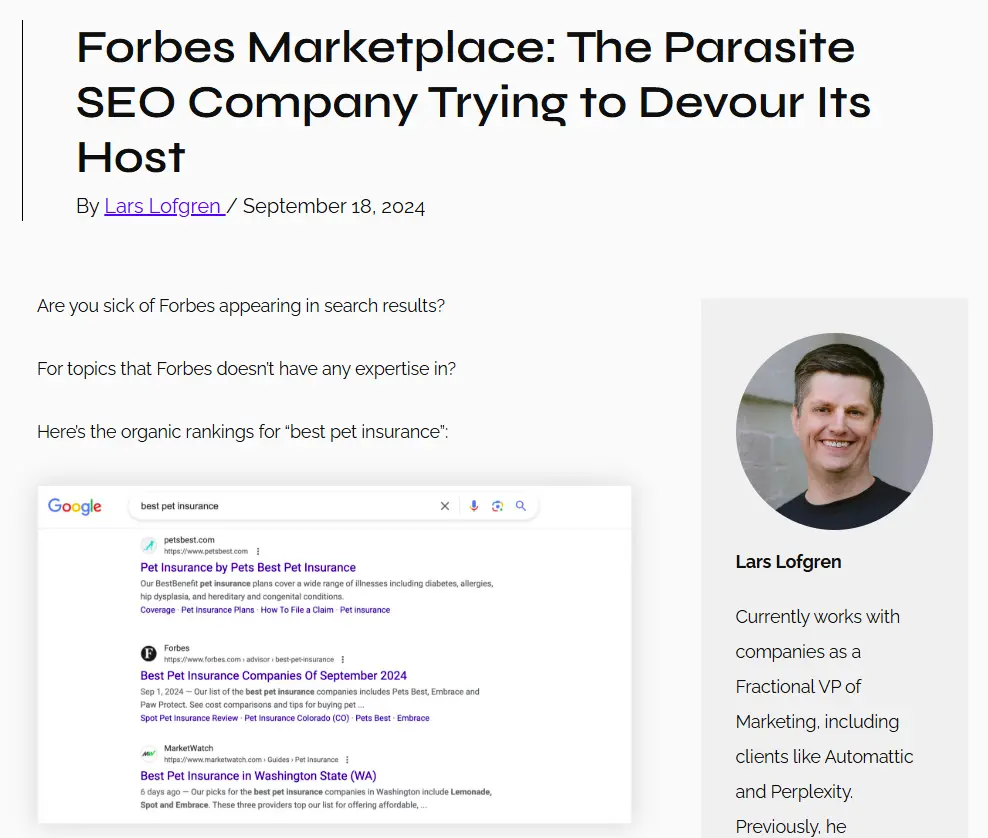
For example, AI Overviews siphon clicks as LLMs race to answer questions directly. Plus, Google’s search engine results pages (SERPs) are now dominated by Reddit and big-brand sites that manipulate results through parasite SEO (e.g., Forbes).
Search Engine Land recently reported that AI Overviews now appear on around 16% of queries, and Ahrefs research shows they cut click-through rates for top-ranking pages by as much as 58%.
Fact is, SEO is harder now than it was three years ago, and anyone telling you otherwise is selling you a lie.
Ryan Law at Ahrefs put it cleanly in a post he shared in 2025:
“SEO offers worse returns than it used to, and SEO is still one of the best marketing channels. Both things are true at the same time.”
What keeps SEO at the top of the list, even as the returns shrink, is the kind of traffic it delivers.
That intent — the buyer typing a question into a search box, looking for an answer — is more valuable than any audience targeting parameter you can buy on a paid platform.
Capturing that traffic, even at lower volumes than five years ago, still beats most other channels on cost per qualified lead.
What SEO content can do for a B2B website
It’s common for business owners to think of blogging as a traffic play. It is, but that’s just the tip of the iceberg when it comes to what your blog can do.
A well-published B2B blog is doing four jobs at once:
- Educate prospects so they arrive at your sales conversations already half-convinced and pre-qualified
- Attract search traffic from buyers who are actively looking for what you do
- Reinforce your money pages through strategic internal linking that passes authority to the service and landing pages where conversions actually happen
- Give your founders and leadership a place to express their thinking, which is the thought leadership play most B2B companies fail at because they treat the blog as a content factory instead of a publishing platform
That last one is underrated.
A blog gives the people at the top of your company (or the people who influence buyer’s decisions) a place to share their point of view, develop their thinking in public, and build a body of work the market can actually engage with.
Each piece then becomes a fishing line you can cast on social media, repurpose into newsletter content, reuse in sales conversations, and link back to from future articles.
But this only works if the content is good.
AI slop published at scale to “win SEO” is the fastest way to lose the bet. Search engines are already filtering for it, buyers can spot it, and your money pages get dragged down rather than lifted up by a library of empty posts.
A quick case study from my client’s blog
I built a new website for a B2B client in Canada back in 2023. The first year after launch was rough. Traffic was low, leads were sporadic, and I ended up making aggressive changes to the site over the next six to eight months — restructuring pages, rewriting copy, tightening the SEO foundation.
They finally broke even and started seeing real ROI by the end of year one. Then in year two we started betting on SEO blog content. Over the past sixteen months, their blog content alone now drives:
- 4x the click-through rate of the rest of the site (0.4% vs 0.1%)
- Average search positions nearly twice as strong (page two vs page four)
- Over a third of all clicks to the entire website
None of that is a viral spike or a paid traffic surge. It’s a slow build, month over month, with each new piece adding to what’s already ranking and pointing readers back to the pages that actually drive revenue.
What can you expect from starting a blog today?
The honest timeline for an SEO bet is twelve to eighteen months before you can fairly say whether it’s working.
Ahrefs studied two million pages and found that only 5.7% reach the top 10 search results within a year, even for low-competition keywords. For high-volume keywords (10,000+ monthly searches), the number drops to 0.3%.
In other words: most pages don’t rank, and the few that do take time. You need enough posts in the ground to give yourself real chances.
The first six months almost always look like failure:
- A handful of impressions show up in Google Search Console, but no one’s clicking
- A keyword moves up a few spots, but it’s not on page 1
- The analytics dashboard looks flat, week after week
It’s no wonder companies cancel their SEO programs at month seven. Heck, I’ve been cut a few times despite my SEO articles becoming top performers on my ex-client’s website.
Would that be an example of a bad marketing bet?
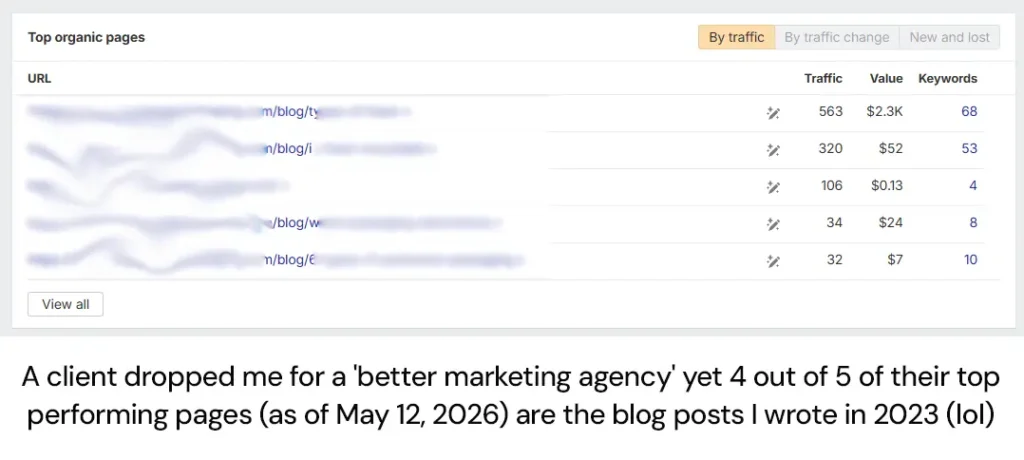
Anyway, my point is folding your hand at month seven kills momentum to get SEO to really work.
Here’s a few signals I look at to ensure I’m winning the SEO long game:
- Impressions rise first, usually within 60 to 90 days
- Keyword positions move up between months three and six
- Clicks arrive in volume around month six and pick up from there
- Backlinks trickle in once you have a body of work worth referencing
- Revenue from organic traffic shows up last, but only if you’ve been targeting commercial and transactional intent keywords
If you’re unsure how to execute an SEO blog strategy for your website, I offer weekly and bi-weekly blog content packages. They’re perfect for B2B businesses ready to commit consistent, quarterly blogs that can help you:
- Drive relevant, qualified traffic from the searches your buyers are actually running
- Educate and nurture new customer relationships
- Position you and your leadership team as thought leaders with quality content you can share on LinkedIn and other social channels
Best of all, if you run on a WordPress website, my team and I can handle uploading, formatting, and scheduling the content for you.
Reach out and let’s talk about what your SEO bet should look like.
No More Bets, Please!
You’ve now seen the three website marketing bets worth placing.
- Website copywriting — the bet that sets the foundation for every other bet. You win this by having the right words on your core pages, targeted to the right buyers who recognize themselves, trust you, and know how to act.
- Landing pages with paid traffic — the bet with the highest and fastest ROI potential. You win this when the right message, on the right page, against the right audience, produces measurable pipeline at a cost you can live with.
- SEO content — the bet most businesses give up on too early. It wins through consistent publishing that delivers steady, inbound leads for months and years to come.
The businesses that win at marketing aren’t placing the most bets. They’re placing the right ones, sticking with them, and watching the leading indicators that tell them when to keep going and when to walk away.
Before you place another marketing bet, ask yourself which of these three you’re already running, which one you’ve been underfunding, and which one you’ve been abandoning three feet from gold.
If you want this to feel less like betting and more like winning, let’s talk.