
Peep Laja and the team at Wynter gave B2B marketing one of its most useful frameworks of the last few years: message-market fit.
The idea is: before you optimize a funnel, before you A/B test a CTA, before you do anything else, your messaging has to resonate with the market you’re trying to reach. If it doesn’t, nothing downstream matters.
I agree with all of it. But I think there’s a deeper layer underneath that most B2B sites are skipping.
Resonance might get a reader to keep reading but:
- Does it get a champion to forward your page to their VP of Finance?
- Does it get a CFO to clear a budget line?
- Does it get an end user to advocate in the next internal meeting?
Each of those are key decisions, and how you communicate that on your website will either help the reader make it or confuse and stall them out.
In this article, I’m going to talk about that layer, which I’ll call: message-decision fit.
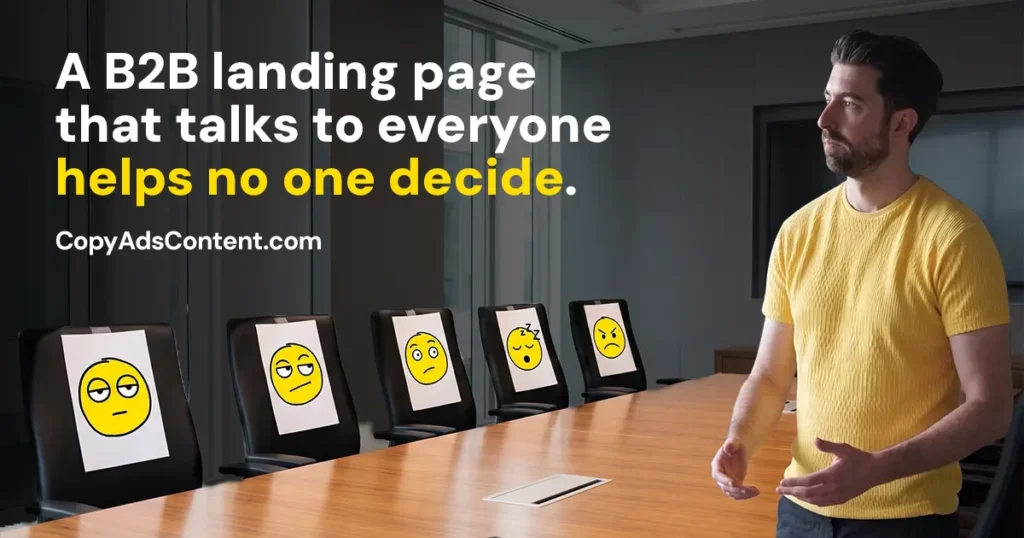
First, what is message-market fit?
“Message-market fit” is term I obsess over when I’m writing copy for B2B websites.
The core claim is that messaging is a product-market problem, not a copywriting problem.
It’s where B2B sites fail not because the writing is bad, but because the messaging — the underlying claim about who you serve, what problem you solve, and why someone should care — was never validated against the people it’s supposed to reach.
Wynter’s whole methodology is built on this.
They run message testing with verified buyers from your target segment, and they’re measuring specific things:
- Clarity (does the reader understand what you do)
- Relevance (does it sound like it’s for them)
- Value (does it solve a problem they actually have)
- Differentiation (does it stand out from the competition).
Message-market fit means those four scores are high enough to keep the reader reading. It’s the floor, not the ceiling.
If any of those scores low, no amount of CTA optimization fixes the page.
Where message-market fit stops working
A page can hit all four of those scores and still not move a deal forward.
That’s because B2B buying isn’t a single act of resonance. It’s a sequence of decisions made by a group of people, often in parallel, as well as in disagreement with each other.
Gartner’s research puts the typical B2B buying group at six to ten decision-makers, each gathering four or five pieces of information independently. The committee then has to converge.
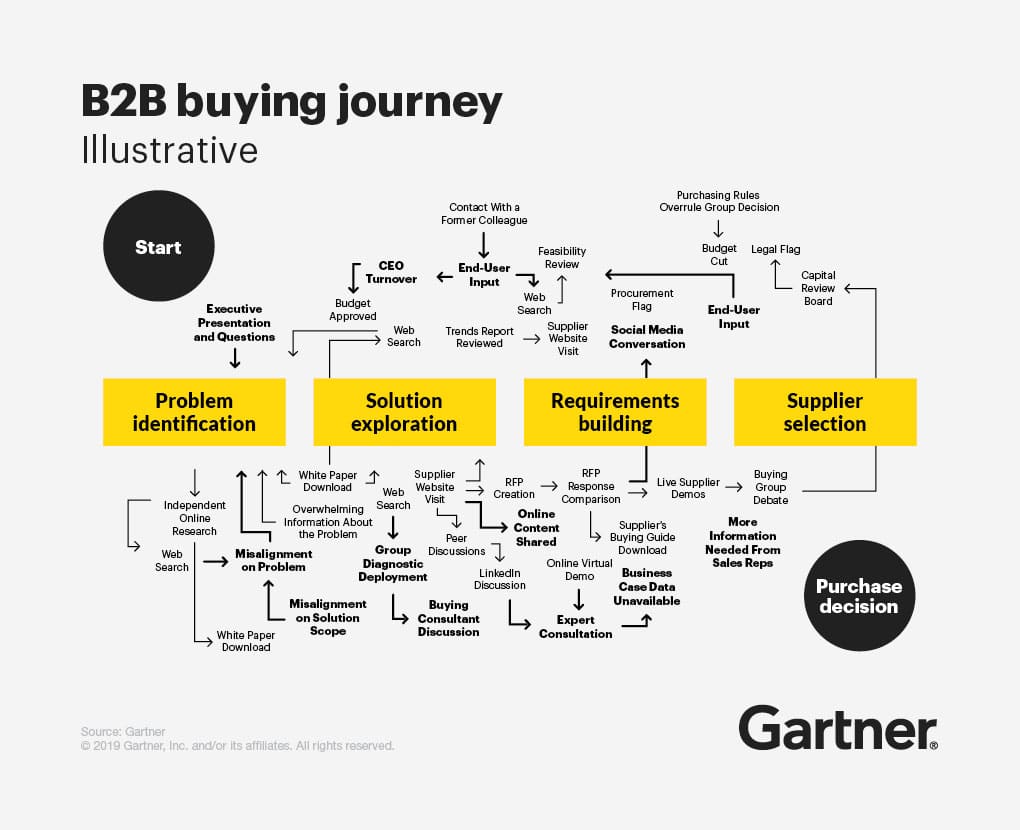
Resonance gets one person nodding. Convergence requires something else. It requires copy that helps each member of the committee make the specific decision they’re in the middle of making right now.
B2B buying is a series of decisions, not a funnel
The funnel metaphor has done the marketing world dirty. It suggests a buyer enters at the top, slides down through specific stages, and either converts or drops off.
That isn’t how committees buy.
Gartner’s buying jobs framework is more practical. A committee is doing six jobs, often in parallel and rarely in order:
- Problem identification
- Solution exploration
- Requirements building
- Supplier selection
- Validation
- Consensus creation
Reframe those as decisions and the website’s job gets sharper:
- Is this a problem worth solving now?
- What kind of solution do we need?
- What must this solution do?
- Which vendor?
- Are we sure?
- Are we aligned internally?
Six decisions, all co-existing at once, all needing different forms of evidence expressed in a web page’s copy.
Because of this, homepage copy that answers the first decision when the reader is making the fourth one isn’t a resonance problem — it’s a decision-fit problem.
The three readers and the decisions they’re making
| The Champion | The Economic Buyer | The End User |
|---|---|---|
| Role: Internal Advocate | Role: Budget Holder | Role: Day-to-Day Practitioner |
| The Core Decision: “Should I stake my reputation on this in the next meeting?” | The Core Decision: “Is this purchase defensible to my boss if it goes wrong?” | The Core Decision: “Do I want to live with this tool every single day?” |
Needs: Ammunition
| Needs: Risk Reduction
| Needs: Workflow Proof
|
| Fails When: You write for the buyer instead of the presenter. | Fails When: You hide the numbers or bury the truth in adjectives. | Fails When: You stay at a “strategic altitude” and skip the “how.” |
A committee of six to ten is too many people to write copy for.
The classic sales frameworks — Miller Heiman’s Strategic Selling, for example — name four buying roles:
- Economic buyer
- User buyer
- Technical buyer
- Coach
That model is built for sales conversations, where you can adapt to each person in the room and ask follow-up questions.
Website copy doesn’t get that luxury. The same page has to do work for all of them at once. So I find it useful to collapse the four into three, because the user buyer and the technical buyer are usually evaluating on similar evidence — does this fit my workflow, will it actually work — and asking different versions of the same decision.
That leaves three readers, each making a fundamentally different decision on the same page. Understand which decision each one is making, and the copy gets a lot easier to write.
The champion: deciding whether to spend political capital
The champion is the person who first noticed your company and started gathering information. They may not be your buyer. Instead, they are someone who has to convince the buyer at their company — their CFO, their VP, their CEO.
The decision they’re making isn’t “should we buy this.” It’s “should I stake my reputation on this in the next meeting.”
That changes everything about what they need from your web pages.
They don’t need to be sold because they’ve already sold themselves. What they need is ammunition:
- Numbers they can quote in a Slack thread
- A one-pager they can paste into a deck
- A framework that makes them sound smart when they bring it up.
The champion is reading your site as a future presenter, not a future buyer. If your copy doesn’t give them something forwardable, you have lost them — not to a competitor, but to the awkwardness of having nothing concrete to bring back to their team.
Most B2B sites fail this reader by writing for the buyer instead. The champion lands on a page that’s trying to convince them, when they don’t need convincing. Instead, they need the ability to convince someone else.
The economic buyer: deciding whether the risk is defensible
The economic buyer is the person who signs. By the time they’re reading your page, the champion has usually already pitched them and they’re checking the work.
The decision they’re making isn’t “is this interesting.” It’s “is this defensible to my own boss if it goes wrong.”
That word—defensible—is the name of the game. In B2B, most buyers are more afraid of looking stupid than they are excited about saving money. They aren’t just buying a solution; they are staking their professional reputation on you. Your copy needs to act as a safety net for their career, providing the evidence, references, and logic they need to prove this was the ‘smart’ choice if things ever get bumpy.
Economic buyers are pattern-matching against risk. They need:
- Pricing transparency: This doesn’t always mean a flat monthly fee for high-ticket B2B, but it requires a pricing framework or a “starting at” range. If they have to hunt for a price, they can’t build a business case—and if they can’t build a case, they can’t defend the purchase to their boss.
- Implementation timelines: They need to plan around resource conflicts. If you don’t tell them how long it takes to get live, they assume it’s a six-month nightmare that will blow their budget.
- Social proof from peers: They aren’t looking for “cool” companies; they want references from organizations that look exactly like theirs. This proves the solution is a safe, repeatable bet.
- Believable business cases: They need ROI data they can repeat almost verbatim when their CFO asks why they approved this. Your copy should give them the script for that conversation.
What they don’t want is:
- A manifesto
- Bold claims and bullshit numbers without proof
- To hunt for pricing
For an economic buyer, the website experience is a sample of the product experience.
Every point of friction they encounter—like a ‘Request a Quote’ button where a price should be, or a vague claim without a case study—is viewed as evidence of future risk
They aren’t just looking for information; they are looking for defensibility. They are already mentally rehearsing the difficult conversation where they have to justify this expense to their boss.
So if your site replaces specifics with flowery adjectives, you aren’t inspiring them; you’re leaving them without a script to defend the purchase when the CFO asks, ‘Why this vendor?’
The end user: deciding whether daily life gets better or worse
The end user is the person who will actually open the software on Monday morning. They have the least formal power in the committee and the most informal power — because if they hate using it, the renewal dies a year later.
The decision they’re making isn’t “is this a good company.” It’s “do I want to live with this thing every day.”
That decision gets made on a very different kind of evidence. End users want:
- Product specifics
- Screenshots that look like the actual interface (not stylized illustrations or AI crap)
- Workflow details.
- To know how it handles the annoying edge case they deal with every Tuesday.
- Some signal that the people who built this have used it.
What they’re trying to figure out is whether your product will solve their problem or become their problem. Vague claims read as a warning sign here — when copy is generic, end users assume the product is too (at least, that’s what I do).
B2B sites that fail here do so by writing exclusively at a ‘strategic altitude’.
They speak in the broad ‘innovation’ terms that CEOs love, but they ignore the reality that specificity is a form of risk reduction. While a VP wants to hear about ‘digital transformation,’ the end user and the CFO both want to know if this software is going to break their current integration on Tuesday morning.
When you refuse to get into the weeds of the workflow, you aren’t being ‘visionary’—you’re being risky.
What message-decision fit failures look like on a service or product page
Failure one: hiding the features
There’s a copywriting cliché that goes “features tell, benefits sell.” It’s half right. Benefits sell when the reader is still asking “why does this matter to me.” Features sell when the reader has already crossed that line and is now asking “how does this actually work.”
Service and product pages that lead with benefits and never get to features lose the end user and the technical buyer in the first scroll. These readers aren’t asking why anymore. They’re asking how. And when the page won’t tell them, they assume the answer is “badly” — or that the company is hiding something.
The fix isn’t choosing features over benefits either. It’s recognizing that different readers need different evidence, and a service page has to deliver both.
Lead with the benefit that frames the decision. Back it up with the feature that proves you can deliver. The reader who needs the benefit gets it. The reader who needs the feature finds it.
Failure two: benefit statements that don’t say anything
“Streamline your workflow.” “Unlock growth.” “Empower your team.”
These read as benefits because they’re written in the grammar of benefits—verb plus aspirational outcome. But they are essentially the junk food of B2B copy: they look like a meal on the page, but they provide zero nutritional value for a buyer trying to make a case.
If you can’t verify it, it isn’t a benefit; it’s a claim. Consider the difference:
- Junk Food Copy: ‘Streamline your HR and empower your team.’
- Decision-Fit Copy: ‘Reduce payroll processing time from 3 days to 4 hours while eliminating manual data entry for managers.'”
They don’t actually name a problem, a mechanism, or a result. They could be pasted onto any service page in any category and still kind of fit, which is the giveaway.
From a decision-fit standpoint, generic benefit statements fail every reader.
The champion can’t forward them because they don’t say anything quotable. The economic buyer can’t build a business case on them because they don’t connect to a number. The end user can’t tell if the product will actually help because the claim is too vague to verify.
A useful benefit statement names the specific problem the reader has, the specific mechanism your service uses to solve it, and the specific outcome they should expect.
The further you can move from generic verbs toward concrete nouns and numbers, the more decision-shaped work your B2B copy does.
Failure three: features without context
The opposite failure shows up on more technical service and product pages. The page is a list of features — twelve of them, sometimes twenty — with no framing for why any of them matter.
This is the page written by an engineer or a product manager for an audience they assume already knows the category. It serves the technical buyer reasonably well and fails everyone else.
The champion has no narrative to bring to their team. The economic buyer can’t tell which features are differentiators and which are table stakes. Even the end user, who you’d think would love the detail, often can’t tell which features solve the problem they came to solve.
This is where the benefits half of the cliché earns its keep.
A feature list with one line of context for each — what problem this solves, who it’s for, why it matters — gives every reader a way in. The page doesn’t get longer, it just gets more readable.
How to audit a service or product page for message-decision fit
Most audits fail because they are looking for “better writing.” But your sales team doesn’t need better writing; they need shorter sales cycles.
Before you open your CMS or edit a single line of copy, you have to accept a cold truth: If a deal stalls after a great demo, your website likely failed to arm your champion for the internal battle that followed.
In other words, get ready to audit not for for clarity; you are auditing for leverage.
You aren’t just auditing for how the copy reads; you are auditing for how it works as a tool for your buyers. Pick one service or product page to start. Don’t audit your highest-traffic page first; start with the one closest to your pipeline, because that’s where decision-fit failures cost the most.
Then, work through the page in four passes:
Pass 1: Who is actually landing here?
You cannot write for everyone at once without becoming generic “junk food” copy.
Pull your traffic data and segment by source to see who is arriving:
- The Champion: Usually the dominant role doing open-web research to see if you belong on the shortlist.
- The Economic Buyer: Often arrives via a direct link sent by the champion to “check the work.”
- The End User: Arrives in waves, typically looking for proof that your tool won’t make their daily life worse.
Once you know who’s landing, the next question becomes answerable.
Pass 2: What is their real “Buying Job”?
Map the reader to the job they are performing. A champion isn’t just “exploring solutions”—they are making a high-stakes social decision
- Try this stress test: Ask, “Does this page give the reader enough ammunition to pitch this to their boss without looking like an idiot?” If they have to “invent” the argument themselves because your copy is too abstract, the page has failed.
That’s a different decision than “is this company good.” The page needs to help them make the decision they actually have, not the one your sales team wishes they had.
Pass 3: Is the copy working or just talking?
Read the page out loud. For every section, put yourself in the shoes of a skeptical CFO or an overworked engineer.
- Evict the “Throat-Clearing”: Identify hero sections and headlines that say nothing. If a benefit like “Unlock Growth” could be pasted onto a competitor’s site, it has zero value for a buyer building a business case.
- Audit the Evidence Clusters: Are your case studies only sorted by industry? A technical buyer often cares less about your industry and more about your specific mechanism for solving their problem.
- The Specificity Rule: Check if you’ve replaced “truth” with “adjectives.” Specificity is a form of risk reduction for an economic buyer.
Be honest about which sections are earning their keep and which are filler.
Pass 4: What is the missing piece?
The gap between what the reader needs to decide and what you’ve given them is your to-do list.
- Add “Missing Evidence”: This might mean finally publishing that pricing framework or implementation timeline so the economic buyer can plan for resource conflicts.
- Kill the “All or Nothing” CTA: If your only button is “Book a Demo,” you’re asking for a marriage proposal on the first date.
You could also offer a “Smaller Decision” that matches their current job:
- “Forward this overview to my team” (Consensus Creation).
- “Add this to my shortlist” (Solution Exploration).
- “View the pricing framework” (Validation).
The point isn’t to add more words; it’s to ensure every word performs decision-shaped work. Resonance gets them to nod; Decision-Fit gets them to act.
Are your pages message-decision fit?
A page has message-decision fitness when a reader can answer four questions about it without you in the room.
- Who lands here?
- What decision are they trying to make?
- What proof or framing do they need to make it?
- What’s the next decision after this one, and does the page hand them off cleanly?
If your sales team keeps getting deals that go quiet after the demo, the copy isn’t failing at resonance. It’s failing at message-decision fit. You likely have a committee reading, they’re just not deciding.
Fix the page for the decision, and you stop being just another vendor. You become the safest, most defensible choice in the stack. Resonance gets them to like you; message-decision fit ensures they aren’t afraid to hire you.