
Before I explain the PAS framework, I want you to picture this:
You’re staring at a blinking cursor, trying to write copy that actually converts, but every draft feels flat, “salesy,” or just plain boring.
Every hour you spend second-guessing your words is another hour of missed leads and wasted ad spend. While you’re struggling to find the “right” hook, your competitors are already out there stealing your market share with messaging that hits home.
Fortunately, you don’t need a creative miracle. Instead,I have a repeatable system that you can use to ethically force people to take action.
See what I did there? That’s the PAS framework in action.
Over my 9+ years in B2B copywriting, I’ve tested a lot of formulas: AIDA, BAB, the 4Ps, FAB—the list goes on. But if you put a gun to my head and told me to pick just one formula for the rest of my career, I’d choose PAS every single time.
PAS — Problem, Agitate, Solve — is the only copywriting frayou ever need. It’s the one I recommend to every client who asks me “how should I structure this email?” or “what’s the best way to open this landing page?” And today, I’m breaking down exactly how you can use it.
(This is part of my complete guide to copywriting formulas — if you want the full breakdown of every framework I know, start there.)
What Is the PAS Framework?
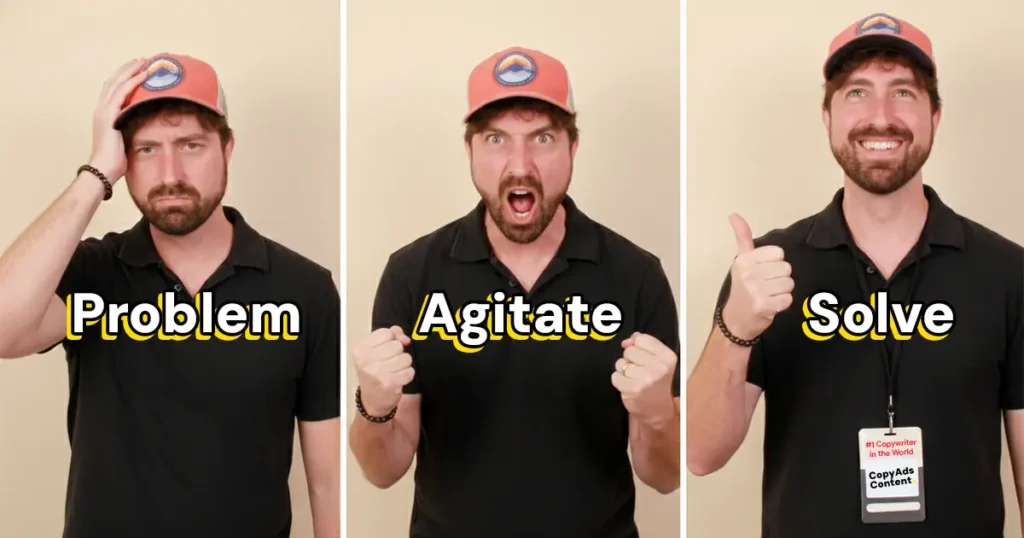
PAS is a three-step copywriting structure:
- Problem — Identify a specific pain point your audience is experiencing.
- Agitate — Twist the knife. Make the problem feel urgent, costly, or emotionally unbearable.
- Solution — Present your product, service, or idea as the answer.
The beauty of PAS framework is its simplicity.
You’re not trying to build desire from scratch like with AIDA. You’re not crafting a narrative arc. You’re doing something far more powerful: you’re meeting someone exactly where they already are — in pain — and showing them the way out.
Where’d the PAS Framework Come From?
The PAS framework doesn’t have a single inventor the way AIDA can be traced back to E. St. Elmo Lewis in 1898.1
Instead, PAS evolved out of the direct-response copywriting tradition — the world of sales letters, mail-order catalogs, and long-form ads where every word had to earn its place because you were paying per page to print it.
The person most closely associated with popularizing PAS is Dan Kennedy, arguably the godfather of modern direct-response copywriting.
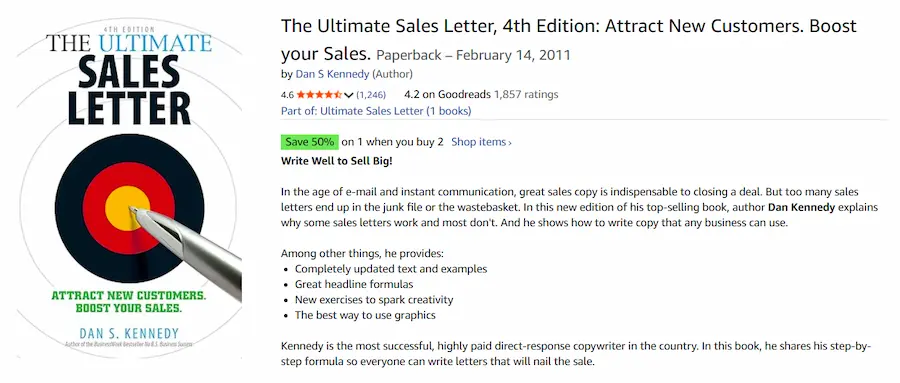
In his book The Ultimate Sales Letter (first published in 1990), Kennedy laid out PAS as the first — and in his view, best — copywriting formula.2 He called it “the most reliable sales formula ever invented.”
Kennedy’s reasoning was blunt: “When you understand that people are more likely to act to avoid pain than to get gain, you’ll understand how incredibly powerful this formula is.”3
That single insight — that humans are wired to run from pain faster than they chase pleasure — is the engine behind every piece of PAS copy ever written. And it’s not just Kennedy’s opinion. It’s backed by some of the most influential research in behavioral science.
The Psychology Behind the PAS Framework
The PAS framework isn’t a hack or a dirty trick. It works because it’s built on how the human brain actually makes decisions.
In 1979, psychologists Daniel Kahneman and Amos Tversky published their landmark paper on Prospect Theory, which earned Kahneman the Nobel Prize in Economics in 2002.4 Their core finding: the pain of losing something is psychologically about twice as powerful as the pleasure of gaining something equivalent. They called this loss aversion.
Think about that for a second. If I offered you $100, you’d be happy. But if I took $100 out of your wallet, you wouldn’t just be unhappy — you’d be roughly twice as upset as you were happy. The emotional math isn’t symmetrical. Loss hits harder.
This is exactly what PAS exploits — ethically, of course.
When you identify the problem, you’re activating your reader’s awareness of a loss or threat. When you agitate, you’re amplifying the emotional weight of that loss. And when you solve, you’re offering relief from that amplified pain. The reader doesn’t just want your solution. They feel like they need it.
Perry Marshall, another well-known marketing strategist, put it this way: a message about the problem can attract 3 to 10 times more engagement than a message about the product itself.5 That’s the agitate step doing its job.
How I Use PAS Framework in B2B Copywriting
Here’s where I’ll get practical, because frameworks are useless if you can’t apply them.
In B2B, your buyers aren’t impulse-purchasing. They’re committee-driven, risk-averse, and drowning in vendor noise. PAS cuts through because it speaks to their reality before it speaks about you.
Here’s a real structure I’ve used for a B2B cold email:
- Problem: “Most roofing companies we talk to are spending $3,000-$5,000/month on ads — and still can’t tell which leads came from where.”
- Agitate: “That means you’re writing checks every month with no real way to know if you’re funding growth or funding waste. And the longer it goes untracked, the more budget you’re lighting on fire.”
- Solve: “I built a lead attribution dashboard specifically for service-based companies. In 30 days, you’ll know exactly which channels are driving real booked jobs — not just clicks.”
If you’re wondering, I build my lead attribution dashboards with Fathom Analytics. I’ll share the details on that another time. Until then…
Airbnb’s “Bedtime” Ad
One of my favorite real-world examples of the PAS framework is Airbnb’s “Bedtime” commercial. It’s elegant in its simplicity:
- Problem: Families with young kids in a hotel — the kid can’t sleep because the parents are stuck in the same room, tiptoeing around in the dark.
- Agitate: The ad shows the frustration. The kid won’t settle. The parents can’t relax. The whole family trip is being derailed by a bad sleep situation.
- Solve: “But if you get an Airbnb, you get to pick your own bedtime.” The family is now in a spacious apartment, the kid asleep upstairs, and the parents enjoying a view of the Eiffel Tower.
I wish my parents took me to Paris (so jealous!).
A Common PAS Framework Mistake Most People Make
Now that you’ve seen the PAS framework in action, here’s the number one thing most people get wrong: they rush the Agitate step.
They’ll name a problem, then jump straight to the solution. But the agitate step is where the sale happens. It’s the emotional bridge between “yeah, I have that problem” and “I need to fix this right now.”
In email marketing, you don’t have much time to beat around the bush. It’s hard enough trying to get someone to open your email. Then when they see a 1,000 word essay pitching a service out of the blue? Yeah, that’s gonna fail.
Dan Kennedy’s sales trainer, Cavett Robert, used to say: “To sell life insurance or cemetery plots, you have to make your customer see the hearse backed up to the door.”6 Dark? Sure. But it illustrates the point — if you don’t make the consequence of inaction feel real, your solution has nothing to land on.
In B2B, agitation doesn’t have to be dramatic. It just has to be specific:
- How much is this costing you per month?
- How many deals have you lost because of this?
- What happens when your competitor fixes this problem before you do?
Specificity is the agitation. Vague problems create vague urgency. Concrete problems create stronger desire to take action.
When to Use the PAS Framework (and When Not To)
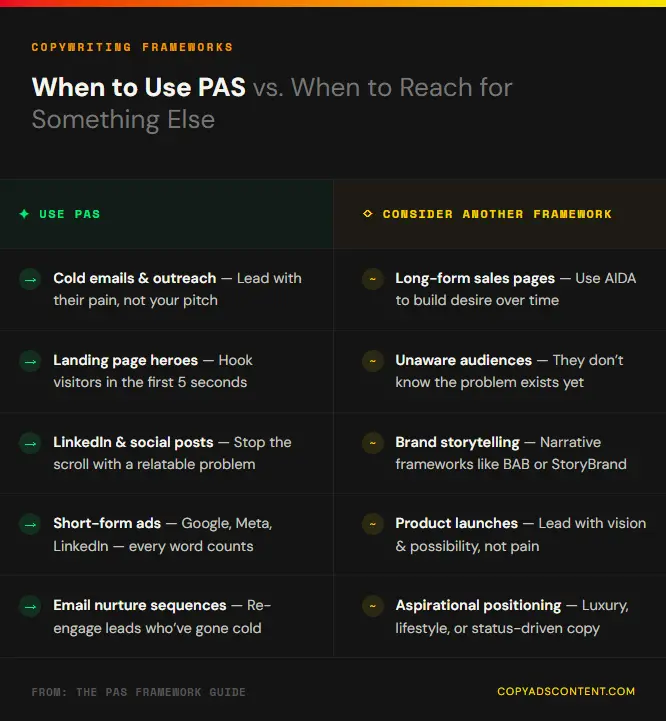
PAS is my default framework for:
- Cold emails and outreach
- Landing page headlines and hero sections
- LinkedIn posts and social content
- Short-form ads (Google, Meta, LinkedIn)
- Email sequences and nurture campaigns
Where I’ll reach for something else — like AIDA or a storytelling framework — is when I’m writing long-form sales pages where I need to build desire over time, or when the audience doesn’t yet realize they have a problem.
PAS works best when your reader is already feeling the pain, even if they haven’t articulated it yet.
How Will You Use the PAS Framework?
PAS framework works because it respects a fundamental truth about human decision-making: we are wired to move away from pain before we move toward pleasure. Kahneman and Tversky proved it. Kennedy built a career on it.
And after 9+ years of writing B2B copy across industries — from HVAC to SaaS to roofing — I can tell you it’s the single most reliable framework in my copywriting toolbox.
- Pick a specific problem.
- Agitate it with a relatable story.
- Show them how you Solve it with your product or service.
Easy, right?
- The AIDA framework (Attention, Interest, Desire, Action) was first outlined in 1898 by advertising pioneer E. St. Elmo Lewis. Wikipedia — AIDA (marketing)
- Dan S. Kennedy, The Ultimate Sales Letter, 4th Edition, Adams Media. First published in 1990. Amazon — The Ultimate Sales Letter
- Ibid. Kennedy’s full quote on PAS from The Ultimate Sales Letter: “When you understand that people are more likely to act to avoid pain than to get gain, you’ll understand how incredibly powerful this first formula is.”
- Kahneman, D., & Tversky, A. (1979). Prospect Theory: An Analysis of Decision under Risk. Econometrica, 47(2), 263-291. Kahneman received the Nobel Memorial Prize in Economics in 2002. Wikipedia — Prospect Theory
- Perry Marshall on problem-focused messaging generating 3-10x more engagement. Hoc Marketing — PAS Framework
- Cavett Robert’s “hearse backed up to the door” quote, as cited by Dan Kennedy in The Ultimate Sales Letter. Book Summary — The Ultimate Sales Letter
What is the PAS framework in marketing?
PAS stands for Problem, Agitate, Solve. It’s a copywriting formula where you identify a specific pain point your audience is experiencing, amplify the emotional weight of that problem by showing the consequences of inaction, and then present your product or service as the solution. It’s used across emails, landing pages, ads, and social content — basically anywhere you need to move someone from “I have a problem” to “I need to fix this now.”
How does the PAS framework improve sales copywriting?
The PAS framework forces you to lead with your reader’s reality instead of your own pitch. Most sales copy fails because it opens with the product. PAS flips that — you start with the pain, which immediately earns attention and trust because the reader feels understood. The agitate step then creates urgency by making the cost of doing nothing feel real and concrete. By the time you introduce your solution, the reader isn’t just interested — they’re actively looking for a way out. It’s grounded in loss aversion research by Kahneman and Tversky, which showed that humans feel the pain of a loss about twice as intensely as the pleasure of an equivalent gain. PAS puts that psychology to work.
What is the difference between PAS and AIDA?
AIDA (Attention, Interest, Desire, Action) is a four-step framework that builds momentum from awareness through to conversion. It’s great for longer-form content like sales pages where you have space to develop interest and stack desire before asking for the action. PAS is leaner — three steps, pain-first, and built for speed. Where AIDA asks “how do I get their attention and build wanting?”, PAS asks “what’s already hurting and how do I make it impossible to ignore?” In practice, I reach for PAS on cold emails, short ads, and social posts where I need to cut through noise fast. I reach for AIDA when I’m writing a longer sales page and need to take someone on a journey. They’re not competitors — they solve different problems.