
| Full name | Herbert Marshall McLuhan |
| Born | July 21, 1911 — Edmonton, Alberta, Canada |
| Died | December 31, 1980 |
| Nationality | Canadian |
| Known for | Media theory; how communication shapes us over time |
| Worth a read | The Medium is the Massage (1967) |
| Additional works | Understanding Media: The Extensions of Man (1964) |
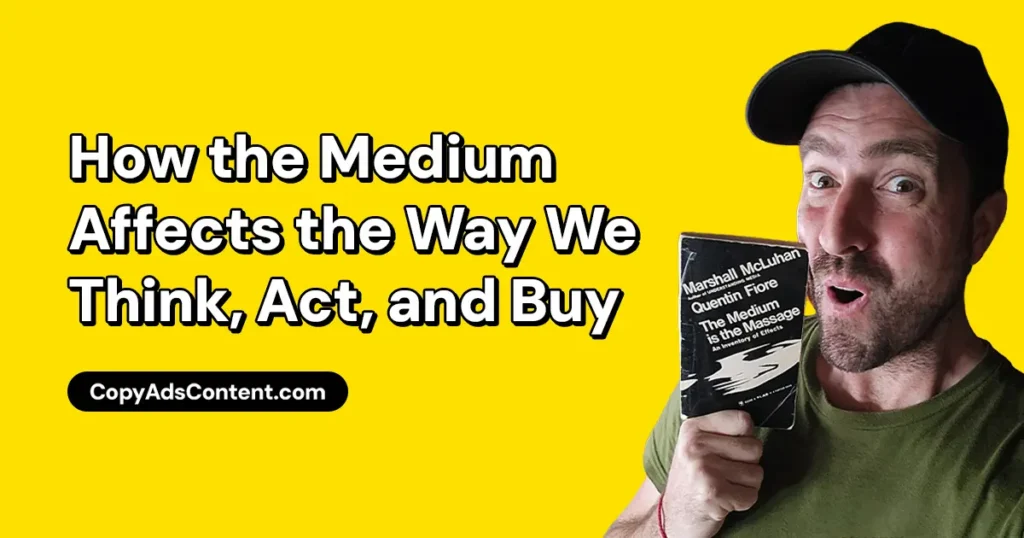
I discovered Marshall McLuhan at a used bookstore when I was a teenager. His book, The Medium is the Massage, was a skinny little thing with an obscure cover and a typo in the title. I remember thumbing through the pages, mesmerized by the randomness and obscurity of all the visuals on each page.
I bought the book for $6 CAD and devoured the entire thing later that evening when I got home. This was the first-ever marketing book I ever read. It also happens to be the book that made me pay attention to how writing works on people. Or, as McLuhan puts it: how writing works us over.
That distinction — between what words say and where the words are published work us over — has become more clear to me as I got older. Yet McLuhan seemed to know exactly where media and marketing were headed when he published his ideas back in 1967.
Who Was Marshall McLuhan?
Marshall McLuhan was a Canadian English professor at the University of Toronto. For most of his career, he wrote dense academic books that almost nobody read. His first book on media, The Mechanical Bride, came out in 1951 and barely registered. The Gutenberg Galaxy followed in 1962 and won him a Governor General’s Award, but stayed mostly inside academic circles.
Then in 1964, he published Understanding Media: The Extensions of Man. That was his real breakout book. It introduced the line he is most famous for, “the medium is the message,” and within two years he had gone from obscure professor to international intellectual celebrity.
Companies like IBM, General Electric, and Bell Telephone were flying McLuhan in from Toronto to lecture their executives. According to a 1965 profile in New York magazine by Tom Wolfe, one American corporation paid him $5,000 for a single closed-circuit television lecture, which is roughly $50,000 in today’s money.
The reason they paid him those numbers is worth understanding, because it explains why McLuhan still matters to anyone writing copy for a business:
- He told IBM, to its face, that it had spent decades thinking it was in the office equipment business when it was really in the information processing business.
- He told General Electric the same thing. They thought they sold light bulbs and lighting systems, when really they were in the business of moving information.
Reframes like that, delivered with the authority of a Cambridge-educated literary scholar, were the kind of thing that made executives pay speaker fees normally reserved for sitting senators.
By 1977, Woody Allen knew McLuhan’s name carried enough cultural weight to use him in a cameo in Annie Hall — McLuhan was actually a last-minute replacement after both Fellini and Buñuel turned the part down.
In the scene, a pompous Columbia professor pontificates in a movie theatre line about McLuhan’s work, until Allen’s character drags the real McLuhan out from behind a poster to deliver the line that became one of the most quoted moments in cinema: “You know nothing of my work.”
What Exactly Did Marshall McLuhan Write?
The Medium is the Massage came out in 1967. It is unlike any book about media before or since. And the title itself is famous for the wrong reason.
“Massage” was a typo. When the proofs came back from the printer, McLuhan’s publisher saw the misspelling and expected him to fix it. McLuhan looked at the page and told them to leave it. He saw right away that the accident was better than the original word.
“Massage” also captures the way media works on us physically. It kneads us. It softens our resistance. It folds in two other meanings at the same time. “Mass age,” the era of mass media. And “mess age,” the disorder it creates. A printer’s mistake became one of the most elegant puns in marketing history.
The book itself works the same way. It is not an argument you read in a straight line but more of a collage of photographs, torn typography, and white space used like punctuation.
McLuhan’s ideas are scattered across pages like the book is performing its own thesis. If you pick it up expecting a normal academic text, you will be confused. But that was the point.
Here is what he was actually saying.
We obsess over the content of any message: the words in the ad, the story in the film, the headline on the page. We ignore the medium that carries it, even though the medium is doing far more work than the message itself, for example:
- Television does not just broadcast shows, it restructures how we pay attention.
- Print does not just deliver words, it created the idea of the private, individual self.
Marshall McLuhan called this process narcosis.
This means we become so used to a media environment that we stop noticing what it is doing to us. The fish, he said, is the last to discover water.
Stripped to its working definition for any copywriter, the idea is simple.
The platform you publish on is already saying something before the reader sees a single word, such as:
- A cold email does not just deliver a message, it interrupts the reader’s day and asks them to trust a stranger.
- A LinkedIn post does not just share an idea, it borrows credibility from the people who liked and commented on it before you scrolled past.
- A landing page does not just describe an offer, it announces that someone is trying to sell you something the moment it loads.
This is what Marshall McLuhan was getting at. It’s not that copywriting changes in any of these places. The medium does. Each medium comes pre-loaded with its own expectation, its own register, its own emotional weight.
The medium has already done its work before your subject line even loads, before your first sentence is read, before the visitor scrolls. It shapes what the reader expects, how much they trust you, and the emotional register they bring to the words you actually wrote.
Why Does Marshall McLuhan Still Matter Today?
Every copywriter working online is operating inside McLuhan’s idea, whether they know it or not. The shape of the medium becomes invisible through repetition, and the content inside it becomes invisible right along with it.
This is why the copy that actually works tends to break the rules of the medium it lives in.
- The email that reads like a note from a friend instead of a broadcast.
- The landing page that opens with a story instead of a headline.
- The B2B article that takes a real position instead of a safe one.
These work because they do something the medium is not expected to do. That gap is what creates the only thing advertising has ever needed: attention.
Which brings me to AI, the newest medium shaking up our world.
AI-written copy is fast becoming a medium of its own, with its own register, its own predictable rhythms, and its own pre-loaded expectation. The AI cold email, the AI LinkedIn post, the AI landing page have all started to sound like the same thing, regardless of which platform they live on.
The medium is announcing itself before the reader gets to the first sentence, and what it is announcing is that the message was not at all written for them (i.e., it’s written by the business, for the sake of the business profiting).
That is McLuhan’s narcosis happening in real time. Anyone leaning fully on AI to do their writing for them is about to find out the hard way that the reader can feel the medium underneath the words.
Now, Marshall McLuhan never wrote an ad in his life. But he understood, better than almost anyone, why the same words in different places get completely different results. The copywriter who ignores the medium is only doing half the job.
I still have my copy of McLuhan’s book. Even though the spine has given up and the pages are falling out, I reread it whenever I feel my writing is not working because it always reminds me of the same thing:
The reader is not just reading my words. They are also reading — and being influenced by — the place I put them.