
TL;DR: Many websites — especially those of small, local businesses — read like corporate diaries, using ‘We,’ ‘Our,’ and ‘Us’ to brag about their history or process. But buyers are inherently selfish — they only care about what’s in it for them. Here’s how to flip the script and turn ‘we’ copy into a language your future buyers actually care about.
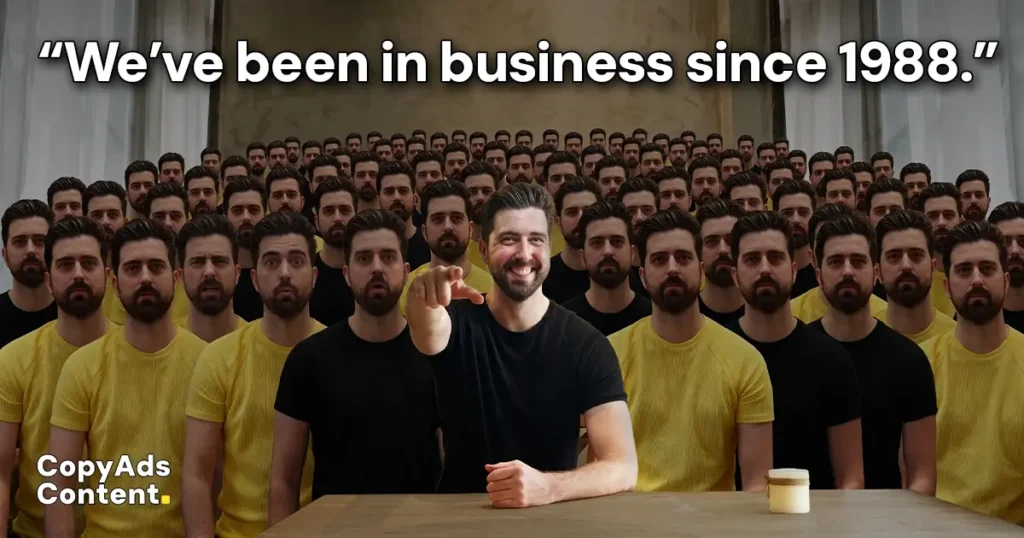
“We’ve been in business since 1988.”
You’ve probably seen a line like the one above slapped across a local business website, branded t-shirts, and the side of company trucks.
Just as Lysol kills 99.9% of germs, I’d bet 99.9% of buyers don’t care about how long you’ve been in business — making the statement completely useless (from a website conversion perspective).
Sure, surviving for a full century might earn you a polite nod and give you something to post about on LinkedIn for a month or two, but longevity doesn’t make you the most capable option to solve a buyer’s immediate problem.
Maybe I’m biased, but the way I trained myself to approach website copywriting is to tune into the one frequency that visitors actually care about:
WIIFM (What’s In It For Me?)
By the way, WIIFM is just the modern shorthand for a much older copywriting principle.
Robert Collier, one of the most successful direct-response copywriters of the early 20th century, put it like this in his 1931 book The Robert Collier Letter Book:
“Always enter the conversation already taking place in the customer’s mind.”
Your buyer is already mid-conversation with themselves about their problem when they land on your site. So if your copy is entirely focused on your own history, your own process, and your own beliefs, ‘we’ copy might be hurting you more than helping.
The Origins of “We” Syndrome
Here’s my theory on why this happens.
Most business owners are great at the sales conversation. They’ve had hundreds of them, and they often say things like:
- “We can come by Thursday at 3.”
- “We’ll inspect the roof.”
- “We’ll provide a quote within 48 hours.”
That’s perfectly fine language — for the sales stage, when the buyer has already raised their hand.
Unfortunately, “we do this” and “we do that” language doesn’t work on visitors who are still in the pre-sale stage. Usually, at this stage, people are still gathering information and comparing their options. Rarely are they ready to be sold on the spot.
This means your pre-sale copy has a different job: it needs to tell visitors whether you’re worth a phone call.
At this stage, the conversation in your buyer’s head looks something like:
- “I have this problem, who can solve it, and can I trust them?”
When your headline simply says, “We’ve been in business since 1995,” it doesn’t answer a single one of those three questions.
So why do businesses keep publishing websites smothered in “we” copy?
Because it feeds the corporate ego. This is the dirty little secret of bad website copy: it gets approved because it makes the founders, owners, and stakeholders feel good.
When upper management reads a homepage that says, “We are the industry-leading experts with a proprietary process,” their brain lights up.
YES, THIS IS US! THIS SOUNDS EXACTLY LIKE WHAT WE DO!
It validates all their hard work, so they approve the copy immediately. But a website isn’t supposed to be written for the CEO; it’s supposed to be written for the stranger who just discovered you and doesn’t have a reason to care yet.
The Psychology of Ego-Driven Copy (and How to Fix It)
Now that we know why the “We” Syndrome happens, let’s look at how to fix it.
To write copy that actually converts, you have to understand how buyers process your words. As I covered in my piece on cognitive overload, every visitor has a limited mental workspace — and every ‘we’ on your page takes a chunk of it.
This pause is what copywriters call the translation tax.
Every time your website screams “We do this” or “Our process is,” you are forcing the buyer to do the heavy mental lifting of translating your internal features into their external benefits. That tax creates friction. And as every good marketer and business owner knows, friction kills conversions.
David Ogilvy, widely considered the “Father of Advertising,” understood this better than anyone.
He famously preached that you should never address your audience as a faceless crowd. You aren’t writing a corporate press release; you are writing a personal letter to one single buyer on behalf of your product, service, or offer.
“The consumer isn’t a moron. She is your wife.”
Translation for the 21st century: stop talking down to buyers with corporate brag-speak. Write to them like they’re a smart person who’s busy.
Look, when your copy is flooded with “We,” you shatter that intimate connection. You position your company as the hero of the story, relegating your buyer to a mere bystander.
Here are four practical ways to flip the script and put your customer back in the spotlight:
1. Shift from Features (“We”) to Benefits (“You”)
The easiest way to cure the “We” Syndrome is to look at your copy through the lens of features versus benefits.
- “We” statements are your features. They describe the mechanism or the service you provide.
- “You” statements are your benefits. They describe the actual outcome the buyer gets to enjoy.
2. Apply the “So That” Rule
Whenever you catch yourself writing a “We” statement, simply add the words “so that you…” to the end of the sentence. Whatever comes after those words is your actual, psychological hook.
- Bad (Ego): “We offer 24/7 technical support.”
- Good (Customer-Centric): “You get your questions answered anytime, day or night.”
- Bad (Ego): “We build high-converting websites.”
- Good (Customer-Centric): “Turn your website traffic into booked sales calls.”
3. Neutralize When “You” Becomes Too Personal
While “You” is the natural antidote to “We,” leaning too heavily on it can occasionally backfire.
In highly regulated industries — legal, financial, medical — or in enterprise B2B where a dozen stakeholders are reading the same page, “You are losing money every day you wait” can feel accusatory or presumptuous. It assumes a relationship that doesn’t exist yet.
Cross-cultural copy is another minefield. Japanese and German business communication, for example, lean formal and indirect. A blunt “You need this” can read as rude.
When you need to neutralize, you’ve got three good moves:
Drop the pronoun and lead with the verb.
- Too aggressive: “You will save 10 hours a week with our software.”
- Neutral: “Save 10 hours a week on manual data entry.”
Frame the outcome instead of the buyer.
- Too personal: “You’ll cut your reporting time in half.”
- Neutral: “Reports that used to take 3 hours now take 20 minutes.”
Use third-person proof.
- Too personal: “You’ll close more deals.”
- Neutral: “Teams using [X] close 30% more deals in their first quarter.”
All three pull the spotlight off both parties and put it on the result — which is what the buyer actually wants to see anyway.
4. Pass the “You-to-We” Ratio Test
A brutal but effective test is to pull up your homepage, hit Ctrl+F, and count how many times you say “We,” “Us,” or “Our.” Then, count how many times you say “You” or “Your.” If the ego words outnumber the customer words, it’s time to hire me to rewrite them.
Wait! Is It Ever Okay to Use “We”?
To be clear, “We” is not a forbidden word. It simply belongs in the right context. Once a buyer is genuinely interested in your offer and moves out of the purely selfish discovery phase, “We” statements become necessary. Here is exactly where to use them:
- The About Page / About section on your homepage: This is the one place on your website where visitors expect you to talk about your history, your team, and your culture.
- Bottom-of-the-Funnel Logistics: Once they are looking at pricing, FAQs, or onboarding steps, they need to know what you are going to do for them (e.g., “We will deliver your first draft within 48 hours”).
- Taking a Stance: If you are expressing a core company value or taking a strong stance in your industry, “We believe…” is a powerful way to draw a line in the sand.
Ready to Stop Talking About Yourself?
Go to your homepage right now and use the Ctrl+F test to count how many ‘we’ statements you’ve used — then read them out loud.
If it sounds like a corporate diary entry — “We’ve been in business since 1995, we specialize in, we pride ourselves on” — your buyers don’t see how you add value and don’t have a reason to convert.
You can fix this yourself by rewriting the page. Try not overfocus on who you are, but instead show them what they get.
Then again, that’s the part most business owners can’t do alone, because they’re too close to their own story. They’ve been telling the “we” version for years and untangling it takes someone with fresh eyes and a copywriter’s mind.
Hey! That’s where I come in.
I’m a pro at rewriting ego-driven websites into customer-centric ones that turn strangers into buyers.
Contact me or book a landing page roast — I’ll tell you exactly where the “we” is costing you conversions.